
Asana Aims to Be Your Top AI Project Management Tool
Project management hub Asana wants to be your go-to for managing AI
In a rapidly evolving digital landscape, project management software giant Asana is making a bold move, positioning itself as the central hub for managing artificial intelligence within organizations. The company is introducing “AI teammates”—intelligent bots designed to integrate seamlessly into project workflows, participating in tasks and discussions much like human colleagues. Unlike many existing AI assistants that cater to individual users, Asana’s AI teammates are built for multi-human collaboration, reflecting the dynamics of a real team. This innovative approach aims to embed AI directly into the established Asana-based workflows that businesses already depend on, ensuring that the integration of AI enhances, rather than disrupts, how work gets done. This article will delve into the functionality, benefits, and strategic vision behind Asana’s latest venture into collaborative AI.
Introducing Asana’s AI teammates: a new era of collaborative work
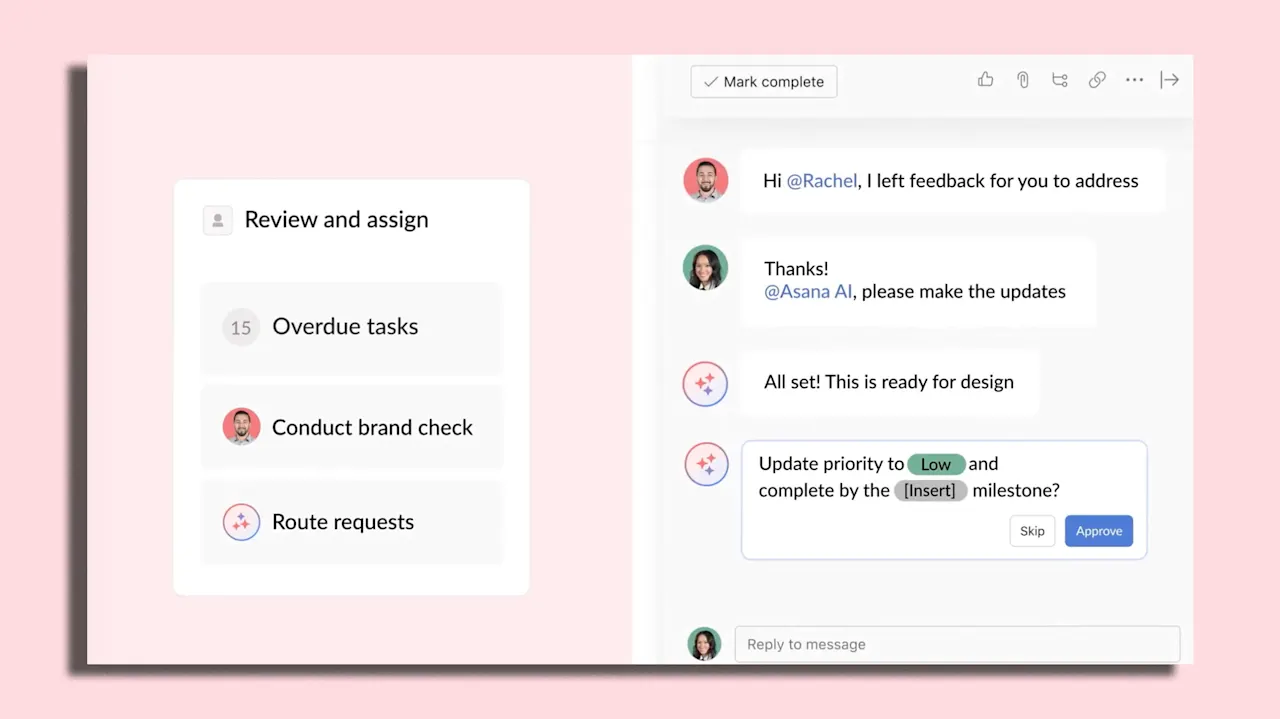
Asana is redefining the interaction between humans and artificial intelligence within project management by launching its groundbreaking “AI teammates.” These are not merely individual AI assistants or copilots; instead, they are designed as integral members of a project team, capable of receiving assignments, providing feedback, and engaging in discussions alongside human coworkers. This represents a significant shift from the typical one-on-one interaction model of many AI tools. Asana’s chief product officer, Arnab Bose, emphasizes this shared experience, noting that an AI teammate will “behave and look like a team member,” able to pick up tasks and receive feedback from any human on the project. This collaborative design aims to foster a more natural and integrated environment for AI adoption, making digital agents feel like genuine extensions of the human workforce.
The core philosophy behind AI teammates is to replicate the human hiring and onboarding process, albeit for artificial intelligence. When an AI teammate joins a project, it becomes visible to all relevant human team members, who can then assign tasks, review progress, and offer guidance. This collective oversight ensures that the AI’s contributions are aligned with team objectives and can be refined through ongoing human interaction. The goal is to move beyond superficial AI assistance to truly embed intelligent agents within the collaborative fabric of an organization, enabling them to contribute meaningfully to complex projects and shared goals.
Deep integration and practical applications
The practical utility of Asana’s AI teammates is immediately apparent through their diverse capabilities and deep integration with existing systems. Asana is launching with 21 prebuilt virtual teammates, each tailored to specific operational needs. These range from strategic roles like planning product launches and drafting marketing campaign briefs to functional tasks such as managing IT service queues and even coding web content. Beyond these predefined roles, users also have the flexibility to create their own custom AI teammates, configuring them with specific prompts to address unique organizational requirements.
A significant aspect of their intelligence comes from Asana’s proprietary Work Graph, a data structure that meticulously maps the relationships between projects, people, and tasks. By leveraging this rich context, AI teammates can better understand their assignments, proactively suggest relevant collaborators, and identify crucial files for reference. This contextual awareness allows them to operate with a higher degree of autonomy and precision.
Moreover, Asana’s virtual teammates are designed to interact seamlessly with external cloud systems, a critical feature for modern distributed teams. They can read and write to files stored in popular platforms like Google Drive and Microsoft SharePoint, meaning they can directly access and contribute to projects within the environments companies already use. For instance, a marketing campaign brief creator can pull in existing notes and high-level strategy documents from these cloud systems to inform its drafts. Future integrations with tools like customer-relationship management (CRM) software are also anticipated, further extending their reach and utility. This cross-platform capability ensures that companies don’t have to overhaul their existing tech stack to benefit from AI teammates, as Bose affirms, “You don’t have to go ahead and learn a new way of working.” They can even process feedback from comments within word processing documents, minimizing workflow disruptions.
Here is a snapshot of some prebuilt AI teammates and their functions:
| AI teammate | Primary function | Example task |
|---|---|---|
| Product launch planner | Strategic project orchestration | Drafting a comprehensive launch timeline with key dependencies. |
| Marketing campaign brief creator | Content and strategy development | Generating a detailed brief for a new ad campaign, referencing past performance data. |
| IT service queue manager | Operational support and task management | Prioritizing incoming support tickets and assigning them to relevant human agents. |
| Web content coder | Technical content generation | Drafting HTML snippets for a new landing page based on design specifications. |
| Deadline risk detector | Proactive issue identification | Scanning Asana boards daily to flag potential bottlenecks affecting project deadlines. |
User empowerment, control, and accessibility
While Asana’s AI teammates are designed for autonomy, a crucial aspect of their implementation is the emphasis on human control and oversight. Asana ensures that users retain fine-grained control over what information their AI teammates can access, addressing common concerns about data privacy and security. Teams can configure permissions, dictating who has what level of control over the bots. For example, advanced users might be authorized to edit an AI teammate’s stored “memory data.” This feature allows for the correction of erroneous instructions or misinterpretations the bot might have acquired from less experienced colleagues, ensuring the AI remains efficient and aligned with organizational goals.
From an accessibility standpoint, Asana is rolling out these features to enterprise customers immediately, with self-service customers gaining access over the summer. The pricing model for AI teammate access is straightforward: it costs $15 per month per user. Importantly, this fee is comprehensive, covering all calls to the underlying AI models. This means customers do not need to worry about separate payments for AI usage or budgeting for AI access tokens, simplifying cost management and providing predictable expenses. While only paying users can directly interact with the AI teammates and issue commands, other Asana users within a project will still be able to observe the bot’s discussions and review any output it generates, maintaining transparency within collaborative efforts. This structured approach to control and cost reflects Asana’s commitment to making advanced AI tools both powerful and manageable for businesses.
Asana’s strategic bet: the ultimate AI management hub
Asana’s foray into AI teammates is more than just a new feature; it’s a strategic declaration of intent: to become the go-to platform for managing AI within the enterprise. In an era where individual contributors are increasingly tasked with overseeing multiple AI agents, the need for a centralized, intuitive system to coordinate these digital entities alongside human teams is paramount. Asana, with its robust project management framework and established Work Graph, is uniquely positioned to fulfill this role. Arnab Bose articulates this vision clearly, stating that “Asana is designed for this moment… It’s designed for this moment where every individual contributor is becoming a manager of multiple AI agents, and you need to coordinate them, and you need to align with other human beings.”
The company’s bet rests on the seamless integration of AI into existing workflows and its collaborative approach. By making AI agents behave like human team members, capable of interacting across cloud systems and drawing context from the Asana Work Graph, Asana aims to minimize disruption while maximizing productivity. This strategy acknowledges that the future of work involves a hybrid human-AI workforce, and effective coordination is key. By providing a unified platform where human managers can assign tasks to, receive updates from, and provide feedback to both human and AI team members, Asana is striving to create an ecosystem that streamlines this complex orchestration. This positions Asana not just as a project management tool, but as an essential operating system for the AI-powered organization.
Asana’s introduction of “AI teammates” marks a significant evolution in how businesses can leverage artificial intelligence for project management. By focusing on collaborative, multi-human interaction rather than single-user assistance, Asana aims to seamlessly integrate AI agents into the very fabric of team workflows. These virtual teammates, ranging from predefined specialists to custom-built bots, draw intelligence from Asana’s Work Graph and integrate with external cloud systems like Google Drive and SharePoint, ensuring minimal disruption to existing processes. Users maintain strong control over AI access and memory, while a straightforward $15 per month per user pricing model covers all underlying AI model costs, simplifying adoption for businesses. Ultimately, Asana is strategically positioning itself as the central hub for managing both human and AI work, preparing organizations for a future where every contributor effectively manages multiple digital agents. This forward-thinking approach could establish Asana as an indispensable platform for optimizing productivity and collaboration in the age of AI.
Tags: asana ai, project management ai, ai teammates, asana work graph, collaborative ai, ai workflow management, virtual assistants asana, enterprise ai tools, asana integrations ai, ai in project management software, asana pricing ai, manage ai agents, digital teammates, future of work ai, human ai collaboration