
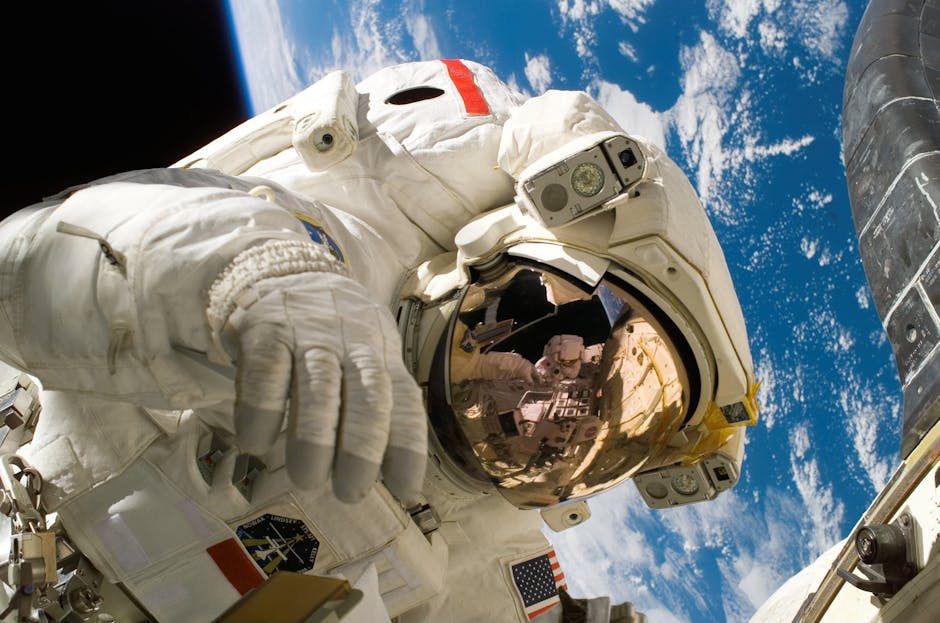
Astronaut's Breathtaking 'Skies of Blue & Clouds of White' from ISS: Dec 8-12, 2025
A celestial canvas unveiled: The ISS perspective
The International Space Station (ISS) offers a vantage point utterly unlike any on Earth, providing its crew with an uninterrupted, panoramic view of our planet. Orbiting at approximately 17,500 miles per hour, astronauts experience 16 sunrises and sunsets every 24 hours, painting the sky with an incredible spectrum of colors, from the deepest indigos of space to vibrant reds and oranges kissing the horizon. From this unique perch, the Earth’s atmosphere, typically taken for granted, reveals itself as a delicate, shimmering veil. Clouds, which appear distant and two-dimensional from the ground, transform into intricate, three-dimensional structures – colossal cauliflower-like cumulonimbus towers, wispy cirrus streaks, and vast, swirling cyclonic systems. The absence of atmospheric scattering from below allows for a clarity that emphasizes the sharp boundary between Earth’s vibrant atmosphere and the stark vacuum of space. This continuous, dynamic display makes every observation a fresh discovery, highlighting the fragility and robust beauty of our home.
December 8-12, 2025: A window of atmospheric wonder
The period between December 8th and 12th, 2025, presents a particularly interesting window for observing Earth’s atmosphere from the ISS. During early December, the Northern Hemisphere transitions deeper into winter, characterized by distinct weather patterns and often clearer skies over continental landmasses, allowing for sharper views of snow-covered terrain contrasting with dark oceans. Conversely, the Southern Hemisphere will be experiencing early summer, potentially revealing vibrant tropical storm systems or extensive cloud formations over warm ocean currents. The ISS orbital path during these specific dates might offer prime viewing opportunities over diverse regions, from the dramatic polar ice caps to the intricate river deltas of equatorial zones. Astronauts would be able to observe the interplay of solar radiation on different atmospheric layers, noting how light penetrates and reflects off various cloud types and landforms. This specific timing also allows for potential observations of specific atmospheric phenomena, such as noctilucent clouds at higher latitudes, or the vivid aurora australis or borealis, depending on the ISS’s orientation and solar activity.
Beyond the visual: Scientific insights from orbit
Capturing the ethereal: Photography and public engagement
The ability to share these extraordinary views with the world is a cornerstone of the ISS mission. Astronauts are often skilled photographers, using advanced digital cameras with specialized lenses to capture the stunning vistas of Earth. These images and videos are meticulously documented and quickly transmitted back to Earth, where they are shared with the global public via social media, NASA’s image galleries, and educational platforms. The impact of these visuals extends far beyond mere aesthetics; they foster a profound sense of global citizenship and environmental awareness. Seeing Earth as a “pale blue dot,” fragile and interconnected, inspires awe and encourages stewardship of our planet. The hypothetical captures from December 8-12, 2025, would undoubtedly contribute to this collective experience, allowing millions to vicariously witness the beauty and complexity of our world from a truly unique perspective. Below is a hypothetical breakdown of content types often shared:
| Content Type | Description | Estimated Frequency (Dec 8-12, 2025) | Engagement Impact |
|---|---|---|---|
| High-resolution stills | Detailed images of cloud formations, land features, atmospheric layers. | 5-7 per day | High – often shared widely, used for educational purposes. |
| Time-lapse videos | Accelerated sequences of orbital passes, sunrise/sunset, weather patterns. | 1-2 per day | Very High – dynamic, captivating, shows change over time. |
| Astronaut commentary/vlogs | Personal reflections, explanations of phenomena, daily life on ISS. | 2-3 overall | High – humanizes the experience, builds connection. |
| Live streaming segments | Real-time views, sometimes with astronaut interaction. | 1-2 overall | Extremely High – immediate, immersive experience. |
No related posts
Image by: Pixabay
https://www.pexels.com/@pixabay